
A second look at every return, cited to primary law.
CitedTax reads a filed return the way a senior technical reviewer would, then walks the Code, the regulations and the published guidance as they stand today. Your firm receives working papers in about thirty minutes: every finding carries its governing authority, its fact-to-law proof chain, its computation, an evidence grade, and a plain statement of what you must validate before relying on it. You decide what the client sees, and the client report goes out under your firm's name.
Built for firms, not consumers. Not tax advice: the reviewing CPA validates every item. Individual, trust, corporate, S corporation and partnership returns.
- 170,000+
- indexed passages of primary and official authority
- 2 layers
- of citation checking before a finding is graded VERIFIED
- ~30 min
- from upload to working papers, review and planning modes in parallel
- 1 firm
- per workspace: your data, your key, your branding
The return was right when it was filed. The opportunity set kept moving.
Returns are prepared under deadline, with the law as it stood and the facts on hand. Then the law moves. Public Law 119-21 alone rewrote pieces of the Code mid-year: domestic research expensing under new §174A with a retroactive election for smaller taxpayers, 100 percent bonus depreciation restored for property acquired after January 19, 2025, a higher SALT cap, new deductions for qualified tips and overtime, a senior deduction, changes to §1202, and a hard stop on several energy credits.
Layer that over TCJA sunsets, indexed thresholds, hundreds of Revenue Procedures and Notices a year, and a letter-ruling record no one can hold in their head.
A second look is not second-guessing. It is the same discipline a firm applies in a technical review, applied to open years under §6511 and to the year ahead, by an engine that has read all of Title 26, all of 26 CFR, the Bulletin, the Manual, the publications and the rulings, and can show its work line by line. Where the return as filed was already right, the papers say so, and that documentation has value of its own.
Open years
Amendable positions inside the refund window, each with its vehicle named: amended return, Form 3115, or a still-open election or contribution window.
The year in progress
Elections and contributions whose windows are still open at the run date, flagged as now-or-never where they are.
The years ahead
Engineering Mode: structures worth building, sequenced as moves, with the interactions and conflicts between them called out.
Three documents per return, each written for a professional reader.
Working papers: Review Mode and Engineering Mode
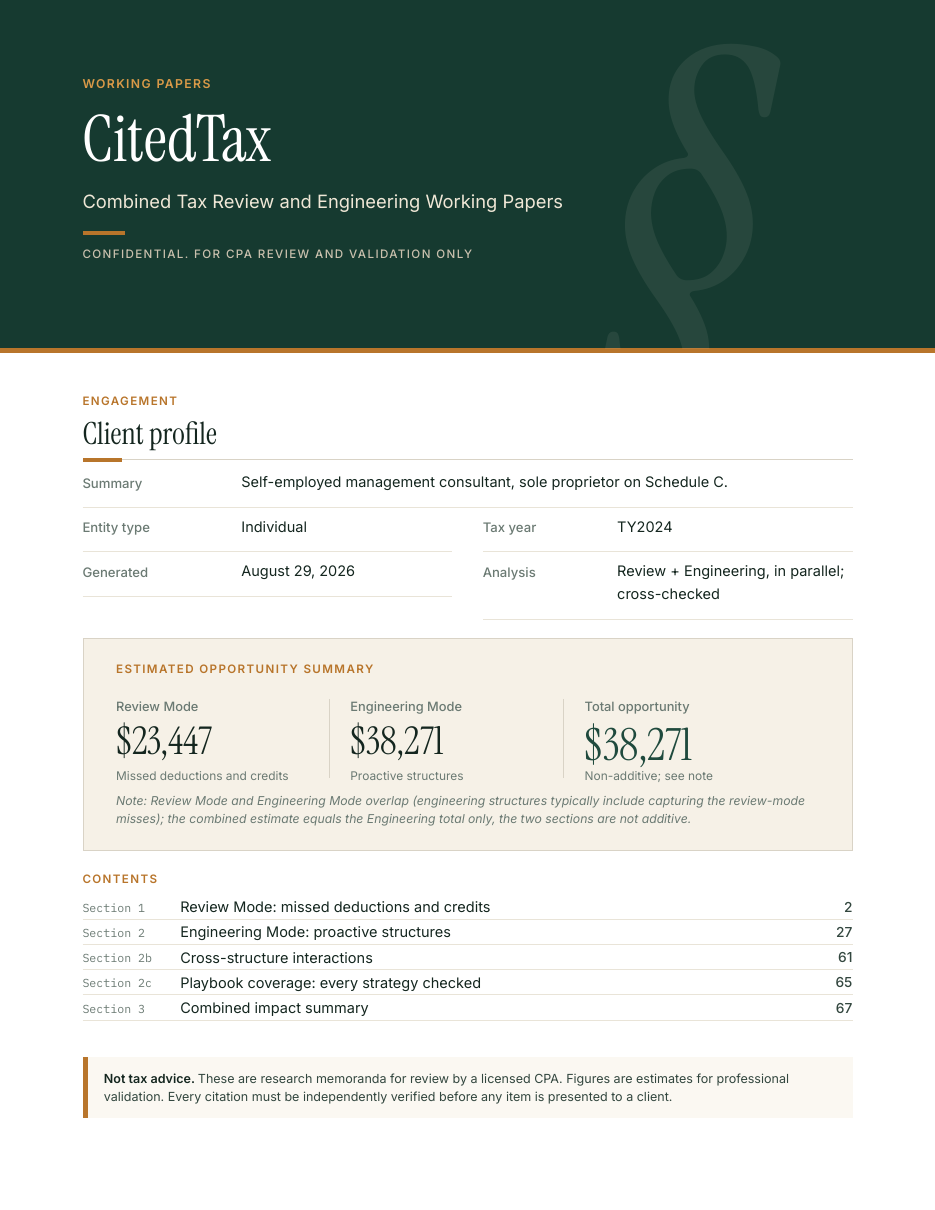
Twenty to forty pages, structured the way a technical-review memo is structured, with room on the page to read them. Review Mode walks the return for deductions, credits, elections and accounting methods that were available and not taken. Engineering Mode inverts the question: what could this taxpayer legitimately build, and in what order?
Every Review finding carries, in this order
- Authority. the IRC section, Treasury regulation, ruling, case or official guidance that governs, with citation key
- Claim. the precise legal proposition the authority supports, no wider than the text
- Fact-to-law. the conditions the authority requires, the client facts that satisfy each, and which conditions remain unproven
- Plain language. two or three sentences you can read to the client, routed through you: "your CPA can" never "we will"
- Why it was likely left on the table. the mechanical reason: a default method, a missed aggregation, an election window, a form the software did not prompt
- Computation. base amount, marginal rate actually applicable, limits applied, and the tax-year assumptions used
- Evidence grade. VERIFIED, CPA TO CONFIRM, or withheld, and why (see grades below)
- CPA must validate. exactly what you have to confirm independently before relying on the item
- Limitations found. phase-outs, thresholds and exclusions in the authority that bite this client
- Examination note. where the position sits on the exposure spectrum and what documentation supports it
Every Engineering structure carries
governing provisions · what must be true · what must change from current facts · feasibility and rationale · the moves in sequence, each with its own authority and grade · combined impact and basis · implementation timeline · the critical dependency · disclosure flags · key risk · what you must validate. Interactions between structures are analyzed separately: conflicts (a move that forecloses another) and synergies (a move that improves another).
And what was considered and excluded. Candidates the engine walked and set aside are listed with the reason. Items withheld by the citation gate or by the return-package cross-check are listed by name. A coverage appendix lists every strategy in the engine's playbook that matches the client's profile, each with a disposition, so a known strategy cannot go missing without a trace. Totals are recomputed from the surviving items at render time and the Review and Engineering figures are never added together; the papers say so on the cover.
Client profile
A three-page structured summary of the facts the engine extracted and relied on: entity, year, filing status, income composition, schedules present, K-1 activity, states, prior positions taken. It is the negative-space map for the review and a fast way to confirm the engine read the return the way you do.
The client report, under your name
Nothing reaches a client automatically. In the curation screen you tick the items worth discussing, edit the plain-language wording in your own voice, add next steps and a cover note, and approve. The report renders with your firm's name, address and colors, in the first person, with an optional authorities appendix, and no mention of CitedTax unless you want one. Items graded CPA TO CONFIRM cannot be included until you mark them confirmed; that rule is enforced in the software, not just in the interface.
Retrieval-grounded research with a hard citation gate, not a chat window.
- 01
Intake and de-identification
The PDF is read as filed: main form, schedules, statements, K-1s wherever they sit in the package, state returns and brokerage bulk summarized rather than dropped. Four-hundred-page bundles are routine; scanned image PDFs are OCR'd.
Before any text reaches a model, Social Security and taxpayer identification numbers, EINs, bank routing and account numbers, phone numbers and email addresses are replaced with stable placeholders, so a K-1 partner still links to the taxpayer without the number ever leaving the intake step.
The result is a structured situation file: entity type, year, filing status, income composition, prior positions taken.
- 02
Enumeration walk
The engine walks the return systematically rather than free-associating.
Individual returns get an individual walk (income character, above-the-line items, itemized versus standard, credits, elections, retirement and health vehicles, TCJA and P.L. 119-21 checklists keyed to the tax year).
Business entities and individuals with Schedule C or K-1 activity also run the credit-recovery walk: statutory credits and incentives in open years, accounting-method opportunities that need no amended return, entity-level elections.
Multistate filers get a multistate walk: sourcing, allocation, other-state credits, resident-state conformity. Prior-year law controls open-year amendments; current law controls prospective items.
- 03
Retrieval against primary and official authority
Each candidate becomes a focused legal question run against an index of more than 170,000 passages: the Internal Revenue Code (with post-P.L. 119-21 text vintage-labeled alongside prior-year text), all of 26 CFR, the Internal Revenue Bulletin 2020 to date, Revenue Rulings, PLRs, TAMs and CCAs, Actions on Decisions, the Internal Revenue Manual examination parts, IRS Publications and form instructions, Audit Technique Guides, JCT Blue Books from 1970 through P.L. 119-21, U.S. tax treaties with technical explanations, and case law.
State stacks are added per jurisdiction. Three are live today:
- California: Revenue and Taxation Code, Title 18 CCR, FTB Legal Rulings, Notices and Chief Counsel Rulings, FTB publications, Office of Tax Appeals opinions.
- New York: Tax Law, 20 NYCRR, TSB-M memoranda and Advisory Opinions, DTF publications, Division of Tax Appeals and Tribunal decisions.
- Massachusetts: M.G.L. c. 62/62B/62C, all 830 CMR 62 regulations, DOR guidance.
The citation gate is jurisdiction-aware, so wrong-state authority is capped rather than passed.
- 04
Grounding and the citation gate
With the retrieved passages in front of it, the model must name the single best authority and write the fact-to-law chain. Two checks follow.
Layer one: the citation key must exist in the corpus. Layer two: the model reads the actual text of that authority and confirms it supports the specific claim as written; if not, the finding is BLOCKED and appears only in the withheld list.
Secondary and procedural sources (Publications, form instructions, the Manual, JCT descriptions) can never carry a VERIFIED grade on a substantive claim; primary law is tried first and secondary support is capped at CPA TO CONFIRM with an explicit caveat. Non-precedential authority (letter rulings, CCAs, AODs) is labeled as such under §6110(k)(3).
Retrieved passageTreas. Reg. §1.199A-1(b)(14)Layer onecitation key exists in corpusLayer twotext supports the claim as written Verified or Blocked - 05
Engineering Mode
Run in parallel with Review Mode. A scan of candidate structures for this fact pattern, a triage for feasibility against the actual numbers, then per-structure engineering.
For each structure: the moves in order, each grounded and graded on its own authority, dependencies and deadlines named (an S election window, a plan set-up date, a Form 709 adequate-disclosure statement), and an interaction pass across structures for conflicts and synergies.
Structures that fail feasibility are reported as infeasible with the reason, not silently dropped.
- 06
Return-package cross-check and render
Every finding or structure above a dollar threshold is tested against the filed return itself: the pages most relevant to it are pulled and a narrow question is asked, whether the return plainly contradicts the premise (the deduction was already claimed, the asset already expensed, the assumed activity does not exist).
Contradicted items are withheld from every list and total and reported by name with the reason and page references.
Only then are the papers rendered, with totals recomputed from surviving items and the non-additive convention stated on the cover.
Two things follow from this design. First, the papers can be wrong in a way you can see: every claim is tied to a passage you can open, and every unproven condition is named.
Second, the honesty layer is structural. The engine flags where a retrieved authority shows an unindexed statutory figure rather than the current-year amount, where a position depends on facts the return does not establish, and where the best available support is secondary. It is built to be checked, because you are the check.
Every item tells you how firmly the text supports it.
Machine-checked against the cited statute, regulation, court decision or officially published IRS guidance: the text supports the claim as written. Actionable subject to the CPA-must-validate conditions listed with it.
The analysis and the math stand as presented, but the best citation retrieved is secondary, non-precedential, or could not be machine-confirmed against the text. Not a rejection and not a statement of ineligibility. Confirm the authority and the flagged facts, then it is actionable like any verified finding.
Administrative execution steps (filing an election, adopting a plan) supported by form instructions or procedural guidance, which is the proper authority for that kind of step.
The supporting citation failed the text check, or the return package contradicts the premise. Shown by name in the withheld list so the sequence stays complete and nothing disappears silently. Not counted in any total.
Grades are evidence labels, not eligibility rulings. Pilot reviewers told us the older word for the amber grade, "unverified", read as "ineligible" to lay readers; it does not mean that, and the papers now say so inline.
Where it fits in a practice.
- 01
Upload
A preparer uploads the filed return PDF into your firm workspace. Redaction is optional; identifiers are removed automatically. One run credit is reserved.
- 02
Overnight, or in thirty minutes
Standard runs go into the overnight batch and are ready by the next business morning, one credit each. A rush run starts immediately and takes about thirty minutes, two credits. Either way you get an email when the papers are ready, and runs that fail on our side return their credit automatically.
- 03
Review and curate
Read the working papers. In the curation screen, tick what the client should see, edit wording, confirm any amber items you have checked, add next steps and a cover note.
- 04
Approve and send
The client report renders under your firm name and is stored encrypted for your retention window (90 days by default, adjustable, purge any time). Approval is recorded: who, when, what was included.
What it is not
- Not a preparer, not filing software, and not a replacement for your research subscription. It is a research and drafting layer that hands you cited memoranda.
- Not tax advice, and it never speaks to your client. The client report is your document, approved by you.
- Not a verdict on the original preparation. Findings are framed around what the law allows now and what windows remain open, not around fault.
- Not a black box. Every claim points to text you can open; every unproven condition is named.
Read the deliverables before you talk to us.
Both samples are rendered from a synthetic fact pattern (a sole-proprietor consultant on Schedule C, TY2024) so they can be shared freely. The working papers show the full structure: cover with recomputed totals, the finding cards with authority, proof chain, plain language, computation and validation notes, Engineering structures with moves and grades, interactions, the considered-and-excluded list, and the playbook coverage appendix, where every cataloged strategy in scope for this profile is listed with its disposition. The client report shows what the same run looks like after a CPA curated it and rendered it under a placeholder firm name.

Built for the questions your managing partner and your IT lead will ask.
No third party touches the return
Your staff upload directly to your firm workspace over TLS. Processing is automated end to end; no CitedTax employee handles a file.
Identifiers removed before analysis
SSN/ITIN, EIN, routing and account numbers, phones and emails are replaced with placeholders before any text reaches a model. Client names are never needed; you type a display name at curation.
Encrypted with your firm's own key
TLS in transit; at rest, every stored object is encrypted with a key unique to your firm on top of the provider's own encryption.
Short retention, your control
The uploaded PDF is deleted as soon as extraction finishes. Papers and reports are kept 90 days by default, adjustable down, purge on demand. No training on your data, no reuse across firms.
Multi-factor sign-in, roles, activity log
Administrator and preparer roles; every upload, download, approval and purge logged and exportable for your written information security plan.
Your compliance file
Security summary for FTC Safeguards Rule / IRS Publication 4557 vendor review, our data-processing addendum, and our position as a service provider under IRC §7216, on request.
A firm license and a flat price per return.
Unlimited users in your firm workspace, white-label client reports, curation, activity log, retention controls, priority support. Month to month.
Bought as run credits in packs of 10, 25 or 100. A standard run (overnight, ready by morning) is one credit; a rush run (about thirty minutes) is two. Credits are available the moment payment clears. A run that fails on our side returns its credit automatically. Card, ACH or invoice.
One free run to try it on a return of your choosing.
What a single finding is worth
Across pilot reviews of filed returns from two states, the working papers surfaced items that ranged from a few hundred dollars a year on a modest 1040 (an unclaimed §199A deduction, a self-employed health insurance deduction, retirement and HSA vehicles still open) to five-figure prospective savings on professional and pass-through clients (a penalty abatement, a cost segregation ceiling, an S election, a state pass-through entity election, defined-benefit plan design).
On one 2024 return the most valuable page was the one that priced the decline of an amendment: the surtax cost exceeded every benefit, and the client had that in writing.
Just as important, the papers documented where returns were already right: a QBI computation verified correct as filed against the return's own worksheets; equipment already fully expensed, so no depreciation opportunity existed. That is the honesty layer working, and it is what makes the rest of the papers credible in front of a client.
At $25 a run, the papers on a single pass-through client tend to pay for the run many times over in billable planning work alone; the license is covered by the first client who says yes to one engineered structure. Figures in the papers are estimates for your validation, never promises, and the papers say so on every cover.
Frequently asked, answered plainly.
Which returns can it read?
Which years and which law?
Which states?
Is this pointing at my work?
How do I know a finding is real?
What if the engine is wrong?
Is this tax advice? Who is responsible?
How is client data protected?
Can we white-label the client report?
How many can we run at once?
Does it replace our research subscription?
What does it cost to try?
Bring us a return you know well.
The fastest way to evaluate CitedTax is to run it on a return whose facts you already know cold, then read the papers with a red pen. Book a thirty-minute walkthrough and we will set up your firm workspace with a free run.
- 01
Thirty minutes
A screen-share through one set of working papers, page by page: grades, proof chains, the withheld list.
- 02
Your return, your facts
Bring a return you know well. We set up your firm workspace and run it on the house, so the second conversation is about your papers, not ours.
- 03
Your questions
Data handling, the §7216 posture, white-label output, and how it fits your review workflow.